
Introduction: Trust Comes Before Sales (Always)
People don’t buy immediately.
Instead, they observe, judge, and compare.
Before a visitor becomes a customer, one invisible question runs in their mind:
“Can I trust this business?”
That single question decides everything.
No matter how good your service is,
no matter how low your price is,
no matter how active you are on social media —
If trust is missing, conversion never happens.
This is exactly where a professional website plays its most important role.
In this article, you’ll clearly understand:
- What “trust” really means online
- How visitors judge your business within seconds
- Why some websites convert visitors into customers
- And why others silently fail
Most importantly, you’ll learn how a website acts as a trust bridge between interest and action.
What Does “Trust” Mean in the Online World?
Trust online is not emotional first.
It is visual and logical.
People don’t know you personally.
So they depend on signals.
These signals answer questions like:
- Is this business real?
- Are they serious?
- Will they respond after payment?
- Do others trust them?
A professional website answers these questions without speaking.
That is its real power.
First Impressions Happen Faster Than You Think
Research shows that visitors form an opinion in less than 5 seconds.
During those seconds, they don’t read everything.
Instead, they scan.
They notice:
- Layout clarity
- Color balance
- Text readability
- Structure
- Overall cleanliness
If the website looks confusing or cheap, the brain assumes:
“The business might also be careless.”
On the other hand, when a website feels clean and organized, visitors think:
“This looks reliable.”
This happens automatically.
Why a Professional Website Feels Safe
Let’s break this down simply.
A professional website usually has:
- Clear headings
- Proper spacing
- Easy navigation
- Simple language
- Consistent design
Because of this, the visitor feels guided, not lost.
As a result, anxiety reduces.
When anxiety reduces, trust increases.
When trust increases, action becomes easier.
That’s conversion psychology in simple words.
Confusion Kills Conversions (Every Time)
Many small business websites fail for one reason:
They confuse the visitor.
Confusion happens when:
- Services are not explained clearly
- Pages are cluttered
- Too many buttons fight for attention
- The message is unclear
When confused, people don’t ask questions.
Instead, they leave.
A professional website avoids confusion by doing one thing well:
guiding attention step by step between website vs social media for business.
How Visitors Decide to Contact You
Visitors usually follow this silent path:
- Who are you?
- What do you do?
- Is this for someone like me?
- Can I trust you?
- What should I do next?
A professional website answers these questions in order.
If even one answer is missing, conversion drops.
Trust Signals That Actually Work
Not all trust signals are loud.
In fact, the strongest ones are subtle.
Real trust signals include:
- Clear “About” page
- Real photos (even simple ones)
- Proper contact details
- Honest service descriptions
- Simple, confident language
These things don’t shout.
They reassure.
Because of that, visitors feel safe moving forward.
Why Social Media Alone Cannot Build Deep Trust
Social media is fast.
Trust is slow.
On social platforms:
- Posts disappear
- Attention is divided
- Ads interrupt
- Competitors appear side by side
Because of this, people scroll instead of deciding.
A website, however, removes distractions.
It creates a focused environment where:
- Your message is uninterrupted
- Your value is explained properly
- Your story makes sense
That focus is essential for conversion.
A Website Turns Interest Into Intent
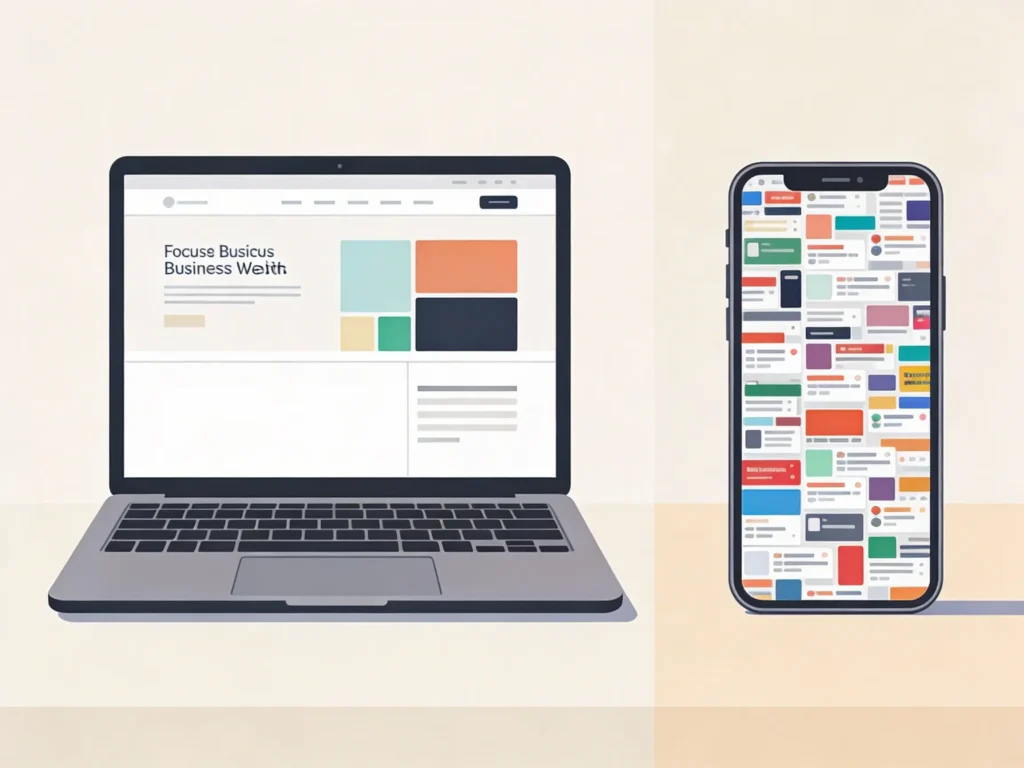
Social media creates curiosity.
A website creates clarity and strong online presence.
Curiosity says:
“This looks interesting.”
Clarity says:
“This is what I need.”
Only clarity leads to action.
Therefore, businesses that depend only on social media often get:
- Likes
- Comments
- Messages
But very few serious inquiries.
A professional website filters casual interest and attracts ready customers.
Why “Professional” Does Not Mean “Expensive”
This is an important misunderstanding.
Professional does NOT mean:
- Fancy animations
- Complex designs
- Heavy graphics
Instead, professional means:
- Simple
- Purpose-driven
- Easy to understand
In fact, simpler websites often convert better.
Why?
Because they respect the visitor’s time.
The Role of Design in Conversion (Explained Simply)
Design is not decoration.
It is communication.
Good design:
- Guides the eyes
- Highlights important sections
- Reduces mental effort
Poor design:
- Distracts
- Confuses
- Tires the brain
When the brain feels tired, it avoids decisions.
A professional website keeps the brain relaxed.
Content That Builds Confidence, Not Pressure
Many websites try to push visitors.
They say:
- “Buy now”
- “Limited offer”
- “Don’t miss out”
However, trust grows better with confidence, not pressure.
A professional website:
- Explains first
- Educates gently
- Invites action naturally
Because of this, visitors don’t feel forced.
They feel convinced.
Why Clear Language Converts Better
Big words don’t build trust.
Clear words do.
Visitors trust businesses that:
- Speak simply
- Explain patiently
- Avoid exaggeration
This is why a good website sounds like a helpful human, not a salesman.
When visitors feel understood, they respond.
Websites Create Long-Term Trust (Not One-Time Attention)
Social media gives short bursts of attention.
Websites build long-term credibility and strong online presence.
Over time:
- Your content ages well
- Google trusts your site more
- Visitors see consistency
Trust compounds.
That’s why older, well-maintained websites convert better than brand-new pages.
What Happens When Trust Is Missing
Let’s be honest.
Without trust:
- Visitors hesitate
- They compare endlessly
- They delay decisions
- They choose competitors
Many businesses think price is the problem.
In reality, trust is missing.
A professional website fixes this silently.
Conversion Is Not Magic — It’s Structure
High-converting websites follow structure:
- Clear introduction
- Logical flow
- Reassurance at every step
- Simple call to action
Nothing is accidental.
When structure is right, conversion feels natural.
Final Truth: Trust Is Your Real Product
No matter what you sell:
- Services
- Products
- Expertise
Your real product is trust.
A professional website packages that trust in a visible, believable way.
Without it, growth becomes slow and unstable.
What You Should Focus On Going Forward
If you already have a website:
- Improve clarity
- Simplify language
- Strengthen trust signals
If you don’t:
- Start simple
- Focus on structure
- Build trust first, sales later
Conversion will follow.