
As an experienced full-stack developer with a decade of exposure to telecom and GIS industries, I’ve seen many businesses grapple with one central question: “How much will my Website Design Costs in India (Freelancer vs Agency vs In-House)?” Whether you’re a startup, a small business, or a growing enterprise, understanding the cost implications of hiring a freelancer, engaging an agency, or building in-house is crucial. In this blog post, we’ll break down each model, show realistic price ranges in Indian Rupees (₹), walk through examples, and highlight the key factors you must consider before choosing your model.
Why Website Design Costs Vary
Before diving into numbers, it’s important to grasp why website design costs in India (or anywhere) vary so widely. Some of the major factors:
- Scope & complexity – Simple 5-page brochure websites cost far less than large e-commerce portals with custom back-end logic.
- Design vs functionality – A basic template setup is cheaper; custom UI/UX design plus bespoke features cost more.
- Experience & expertise of the provider – A veteran freelancer or premium agency will charge more than a newcomer.
- Engagement model (freelancer vs agency vs in-house) – Overheads, process maturity, support, and deliverables differ across models.
- Recurring & hidden costs – Maintenance, hosting, domain, updates, plugins/extensions. These aren’t always included in the “design” cost.
With these in mind, let’s compare the three models.
1. Freelancer Model
What it means
Hiring a freelance web designer/developer means you engage one person (or a very small team) who handles the design (and sometimes development) of your site. They tend to have lower overheads, more flexibility, and are suitable for smaller projects.
Cost Range in India
Here are realistic cost ranges (₹) for freelance work:
- Hourly rates: For freelancers in India, junior designers might charge ₹500 – ₹2,000/hour.
- Project cost (for typical business websites):
- Basic small business website: around ₹10,000 – ₹25,000.
- More complex freelance projects: up to ₹50,000 – ₹1,50,000 depending on features.
- For design (UI/UX) focus: Template-based design might start from ₹5,000 – ₹15,000, custom design could be ₹30,000 – ₹1,50,000+.
Example Use-Cases
- A freelancer builds a 5-page WordPress site with a premium template for a local business: cost maybe ₹15,000–₹25,000.
- A freelancer builds a more bespoke site (10-20 pages, custom branding) for a startup: cost around ₹40,000–₹80,000.
- A freelance specialist does full UI/UX redesign + development for a service provider, 20+ pages: cost could hit ₹1,00,000+.
Pros & Cons
Pros:
- Cost-effective for smaller projects.
- Direct communication with the person doing the work.
- Flexibility and faster turnaround if scope is small.
Cons:
- Limited capacity: if the freelancer gets busy or is unavailable, delays can happen.
- Might lack certain specialised skills (e.g., full stack dev, advanced features) or team backup.
- Risk of poorer process/documentation compared to a structured agency.
When to pick freelancer
If you have a modest budget, simple requirements (few pages, minimal custom features), and you’re comfortable working closely with one person, a freelancer is a solid choice.
2. Agency Model
What it means
An agency is a formal company with a team: designers, developers, project managers, QA, maybe SEO/marketing support. They bring more structure, process maturity, and reliability than a lone freelancer.
Cost Range in India
Here are typical cost bands for agencies:
- Hourly rates: Agencies may charge ₹2,500 – ₹10,000/hour or more, depending on size, brand, and specialisation.
- Project cost:
- Basic business website: starting around ₹30,000 – ₹70,000.
- Medium project (10-20 pages, custom branding, moderate functionality): ₹50,000 – ₹2,00,000+.
- Large/custom website (e-commerce, many pages, complex integrations): ₹1,00,000 – ₹5,00,000+.
- Design-only estimate: A custom UI/UX job via agency for template vs full custom: template-based might cost from ~₹45,000–₹85,000; totally custom UI/UX from ~₹75,000 onwards.
Example Use-Cases
- A small business hires an agency to design and develop their website (8–10 pages, responsive, brand alignment): cost ~₹50,000–₹90,000.
- A mid-sized firm hires an agency for a website with 20–30 pages, blog, CRM integration, SEO prep: cost ~₹1,50,000–₹3,00,000.
- A large retailer hires an agency for a full e-commerce website with custom backend, 1000+ products, user accounts: cost could go to ₹5,00,000 or more.
Pros & Cons
Pros:
- End-to-end service: design, development, QA, often post-launch support.
- Better reliability & accountability (you have contracts, multiple team members).
- Better suited for bigger projects or those needing integrations & scalability.
Cons:
- Higher cost.
- Potentially more process overhead and slower initial ramp-up.
- May feel less personalised than working directly with a freelancer (you might deal with a project manager rather than the designer/dev).
When to pick an agency
If you have moderate-to-large budget, need more features, expect growth, want less management overhead, and care about quality, long-term support and brand impact — an agency is the wise choice.
3. In-House Model
What it means
Here you build your web team within your organisation (you hire full-time designers/developers, pay salaries/benefits, manage everything). This model is common for companies whose website is central to their business (e.g., products, SaaS companies, large enterprises).
Cost Implications in India
While design‐only numbers for in-house are less talked about, you’ll incur:
- Salaries + employment overheads (PF, benefits, office space, tools)
- Infrastructure (hosting, licences, CMS, plugins)
- Training, management, employee downtime
- Opportunity cost (employees focus on one website vs diversifying)
For example, hiring a mid-level web designer/developer in India could cost a few lakhs per year in salary (₹3-6 lakh+ depending on city & skill) or more.
Plus, if you need multiple staff (designer + coder + SEO + content) your annual cost can multiply.
Example Use-Case
A growing tech company decides the website and associated UX/UI must be constantly iterated, so they hire: one UI/UX designer (₹6 lakh/year), one frontend developer (₹7 lakh/year), and one content/SEO person (₹5 lakh/year) — plus overhead. So total ~₹18–20 lakh per year before infrastructure costs. Over 2-3 years, this cost surpasses many agency project costs.
Pros & Cons
Pros:
- Full control over team, process, iterations.
- Full-time focus means fast turnaround and internal alignment with business goals.
- Good if web is core to your business, and you expect many changes/iterations.
Cons:
- High fixed cost; may not be cost‐effective if website is a one-off or not central.
- Managing a team and infrastructure is overhead.
- Risk of resource under-utilization if workload is irregular.
When to pick in-house
When your website (or web app) is central, you need continuous updates, you have budget and capacity to manage a team, and you foresee frequent iterations or scaling — in-house makes sense.
Comparative Snapshot
| Model | Typical Budget (₹) | Best Suited For | Key Trade-Offs |
|---|---|---|---|
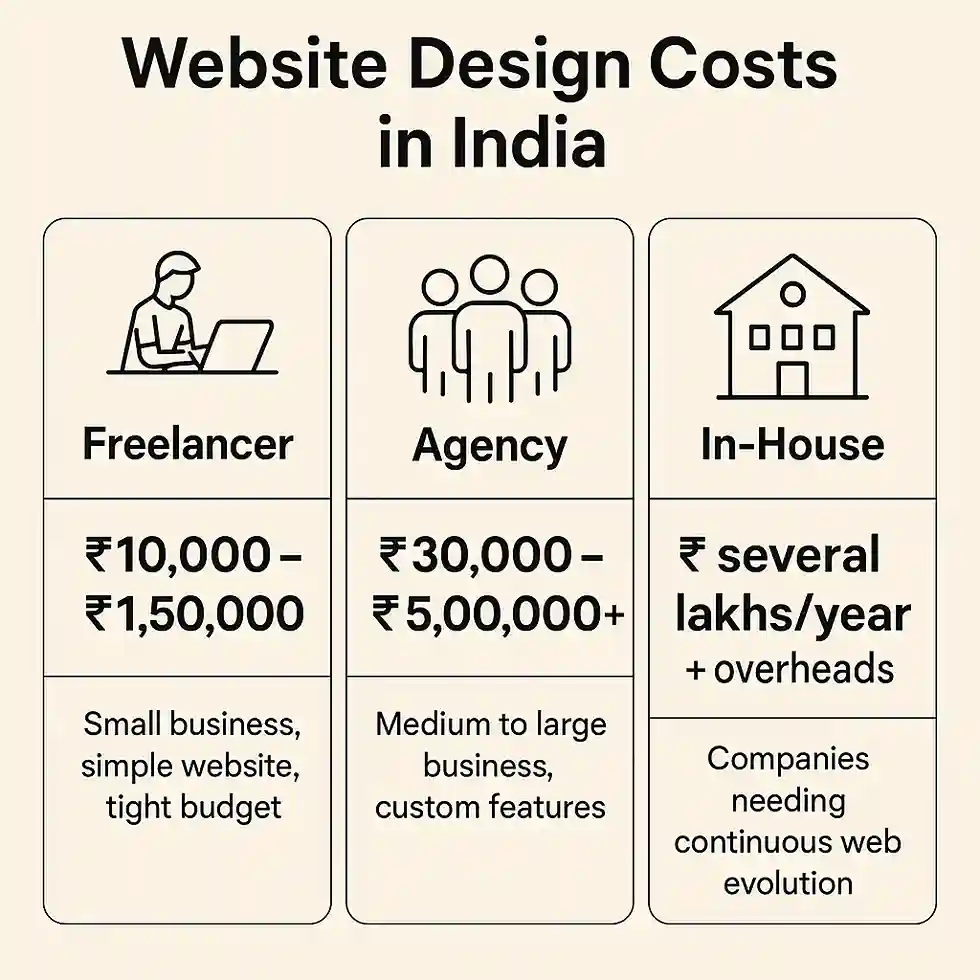
| Freelancer | ₹10,000 – ₹1,50,000 | Small business, simple website, tight budget | Lower cost, less backup/scale ability |
| Agency | ₹30,000 – ₹5,00,000+ | Medium to large business, custom features | Higher cost, slightly less direct control |
| In-House | ₹ several lakhs/year + overheads | Companies needing continuous web evolution | Highest cost, management overhead |
Note: These numbers are indicative ranges. Your specific cost will vary depending on the factors outlined earlier.
Realistic Price Ranges by Scenario
Here are a few realistic “packages” you might encounter in India, mapped to the model and typical deliverables.
- Startup / Local Business – Minimal website (5 pages, template, no major custom features)
- Freelancer: ~₹15,000–₹30,000
- Agency: ~₹35,000–₹70,000
- In-house: Not practical unless you have other continuous web needs
- Growing Business – Medium website (10-20 pages, custom branding, blog, basic integrations)
- Freelancer: ~₹40,000–₹80,000
- Agency: ~₹1,00,000–₹2,50,000
- In-house: Could be ≈ ₹10–15 lakh/year if you build team
- Large Business / E-commerce – Many pages, product listings, user accounts, custom backend
- Freelancer: Might be feasible if very specialized but risky; cost ~₹1,50,000+
- Agency: ~₹2,00,000–₹5,00,000+ (or more depending on scale)
- In-house: Likely the best long-term if frequent updates; cost several lakhs/year
For example, one source states: “A freelancing developer cost can range from ₹15,000–₹80,000 for complete projects, while agencies charge ₹30,000–₹1,50,000+.” American Chase Another indicates for custom websites with unique features: ₹2,00,000–₹6,00,000. iTrobes
Hidden / Recurring Costs You Must Budget For
- Domain & Hosting: Domain registration ~₹500–₹2,000/year; Hosting (shared to dedicated) could be ₹400 to ₹20,000/month depending on traffic.
- Premium Themes / Templates / Plugins: For example, themes ~₹3,000–₹10,000+, plugins ~₹2,000–₹15,000 and up.
- Maintenance & Updates: Regular updates, security patches, content changes. One source quotes website maintenance at ~₹2,500–₹5,000/month for 15-20 page site.
- Content Creation, SEO, Graphics: These are often separate from pure “design” cost; you might need to budget ₹5,000–₹20,000+ depending on scope.
- Revision Cycles & Scope Creep: If you keep asking for changes, the cost/time increases. Choose clearly defined scope and sign off deliverables.
- Future Scalability / Integration: As your business grows, you may need new sections, modules, multilingual support, e-commerce, etc. These add to cost.
How to Choose the Right Model
Here is a checklist to help you decide:
- What’s your budget? If you are very constrained, freelancer might be the right starting point.
- What’s your timeline? Freelancers may be faster for small scopes; agencies provide structure but may take longer.
- What’s the complexity & scale? If you just need a brochure site, go simple. If you require custom workflows, integrations, heavy traffic, pick agency or eventually in-house.
- How often will you update/change the website? If constant updates, in-house might pay off. If occasional updates, freelancer/agency is better.
- What about control and reliability? If you want someone you can directly manage and less overhead, freelancer; if you prefer a one-stop solution with teams and backup, agency.
- What about long-term plan? If website will evolve into a business critical asset, invest properly now so you don’t pay twice later.
- Are you comfortable managing resources? In-house means you take on hiring, HR, infrastructure; freelancer/agency lets you outsource that.
My Take (As a Freelance Full Stack Developer with 10+ Years Experience)
Given your context—if I were advising you (Mahesh) or you were advising a client—the following perspective applies:
- If you (or your client) are a small business looking to establish an online presence, I’d recommend starting with a reliable freelancer (with good reviews/portfolio) to keep things lean and focused. From ₹20,000–₹60,000 you can get a solid site.
- If the business expects growth, brand focus, multiple pages and possible integrations (say CRM, payments) I would go for a mid-sized agency and budget ~₹1–3 lakh.
- If your website is going to be the backbone of your business (e.g., SaaS, marketplace, large scale) then building an in-house team makes sense — but keep in mind the minimum investment is significantly higher (several lakhs/year) and you must have enough ongoing volume of work to justify it.
Also remember: price alone does not guarantee success. Quality of design (UX), responsiveness, performance (speed), SEO, mobile-readiness, security, maintenance—all matter. Often paying a bit more upfront avoids paying much more to fix things later.
Final Thoughts
- Website design costs in India vary widely, but realistic ranges for 2024/2025 are:
- Freelancer: ₹10,000 – ₹1,50,000+
- Agency: ₹30,000 – ₹5,00,000+
- In-house: ₹ several lakhs/year + overhead
- Always clarify: what’s included in the quote (pages, features, mobile/responsive, CMS, updates, maintenance).
- Build a clear scope, sign contract, set milestones and revision limits.
- Budget for ongoing maintenance and upgrades, not just “set it and forget it.”
- Choose the model that aligns with your business stage, budget, needs and future trajectory.